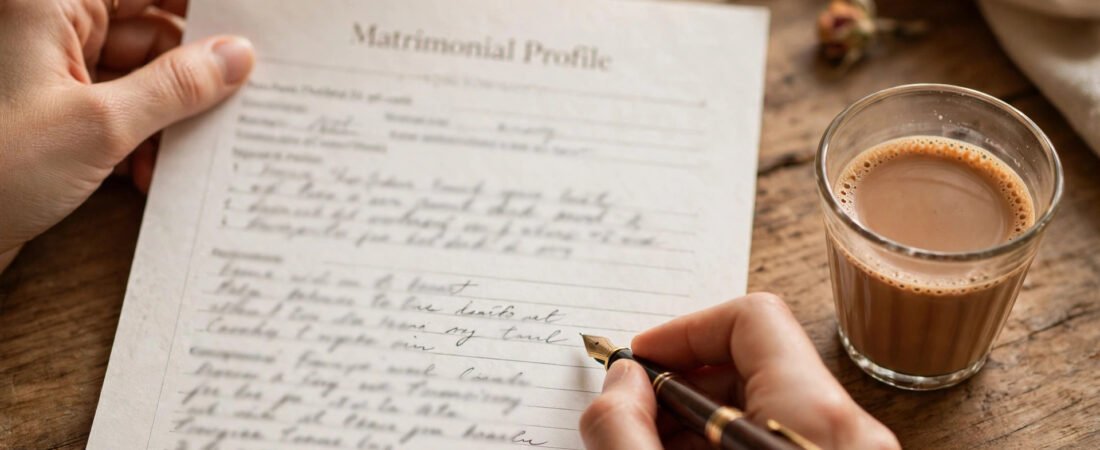
A matrimonial profile is often the first introduction between two people and their families. In Pakistan, where marriage decisions usually involve both personal choice and family discussion, a well-written profile can save time, prevent misunderstandings, and help the right people start a conversation. A respectful profile does not try to impress everyone. Instead, it presents honest information in a clear way, so readers can decide calmly whether there is a genuine basis for further contact.
Creating such a profile takes a little thought. Consider what is essential to know, what can be discussed later, and what should remain private until trust is established.
Start With Honest Basic Information
Begin with the facts that most families look for first: age, city of residence, education, and current occupation or stage of life. These details help readers understand context without having to ask basic questions repeatedly.
Be accurate rather than approximate in a misleading way. If you are completing your studies, say so. If you are between jobs or preparing for an exam, a brief honest note is better than a vague title that creates a false impression. Accuracy builds trust from the start, and trust matters far more than a polished but unclear description.
You do not need to share highly sensitive information in a public profile. Exact home addresses, identity document numbers, phone numbers, and detailed financial information should never be included. Share contact details only through a trusted channel, and only when you and your family are comfortable doing so.
Describe Education and Work Clearly
Education and work are important parts of life in Pakistan, but they should be described simply and without exaggeration. Mention your highest completed qualification, the field of study, and, if relevant, the institution type or city. For work, state your profession, the sector you work in, and whether your work is based in Pakistan or abroad.
For example, a generic description such as “a 26-year-old teacher from Lahore who teaches at a private school and is completing a master’s degree part-time” gives a clear picture in one sentence. It is specific enough to be useful, but it does not reveal private details.
If your career plans may affect married life — for example, a possible move to another city, shift work, or further study — mention this briefly. Early clarity helps both sides avoid difficult surprises later.
Talk About Values, Not Just Requirements
Many profiles list what they are looking for but say very little about the person themselves. A more helpful approach is to describe your own values and lifestyle first, and then explain what kind of partnership you hope for.
Values and lifestyle
You might mention the role of family in your daily life, your approach to religion, your interests outside work, and how you spend your free time. Keep this section warm and ordinary. Small, honest details — enjoying reading, helping in a family business on weekends, or preferring a quiet home life — often communicate more than broad claims about personality.
Avoid describing yourself only with adjectives such as “simple,” “decent,” or “well-mannered” without any supporting detail. Those words are common and well-intentioned, but readers learn more from a short example of how you live.
Partner preferences
When stating preferences, focus on compatibility rather than a long checklist. Age range, education background, city or willingness to relocate, and broad lifestyle expectations are reasonable to mention. Be careful with language about appearance, complexion, wealth, or family status. Demanding or dismissive wording can discourage respectful readers and does not help you find a compatible match.
A preference is more helpful when it explains why it matters. For instance, preferring someone based in the same city because elderly parents need support nearby is clearer and more understandable than simply writing “only local proposals.”
Use Language That Is Courteous and Clear
Tone matters. Write as if you are speaking to a respected family you have just met. Use complete sentences, avoid slang and excessive abbreviations, and read the profile aloud once to check that it sounds natural.
Avoid pressure or urgency in your wording. Phrases that suggest a family must decide immediately, or that only a certain type of proposal will be “entertained,” can make readers uncomfortable. A calm invitation to discuss further, through families or a trusted intermediary where preferred, is usually more effective.
If the profile is written in English but your family usually speaks Urdu or a regional language at home, that is fine to note. It helps set expectations for the first conversation and makes the meeting more comfortable for everyone.
Think Carefully About Photographs
If the platform or family custom allows a photograph, choose a recent, clear, and modest image that looks like you in everyday life. Avoid heavily filtered images, group photos where it is unclear who the profile is about, and pictures taken in private settings that you would not want shared widely.
Some people prefer not to share a photograph publicly for personal or family reasons. That choice should be respected. In that case, you can note that a photograph can be shared privately at an appropriate stage, through family, if both sides wish to proceed.
Never use someone else’s photograph, an old photograph that no longer reflects your appearance, or an image edited to change how you look in a significant way. Misleading photographs undermine trust before a conversation has even begun.
Involve Family in a Balanced Way
In many Pakistani families, parents or elders help create and review a profile. Their involvement can be a strength: they may notice missing information, suggest more respectful wording, and help screen initial enquiries.
At the same time, the profile should reflect the person who is to be married, not only the family’s wishes. If there is a difference between what the individual wants and what the family has written — for example, about living arrangements after marriage or plans to work — it is better to discuss and resolve that difference privately before the profile is shared.
Decide in advance who will respond to enquiries, how quickly, and what the next step will be if both sides are interested. A clear process prevents confusion and repeated calls.
Review, Update, and Respond Respectfully
A profile is not a one-time task. Review it every few months and update anything that has changed, such as a completed degree, a new job, or a change of city. Remove outdated information promptly.
Finally, how you respond to enquiries is part of your profile’s reputation. If a proposal is not suitable, a short, polite decline is enough. There is no need to give detailed reasons or criticise the other family. If there is interest, suggest a structured next step, such as a family phone call at an agreed time.
Conclusion
A respectful and helpful matrimonial profile in Pakistan combines honesty, clarity, and courtesy. It gives enough information for families to make an informed first decision, protects private details, describes values as well as preferences, and invites conversation without pressure. Taking time to write it carefully is a small effort that can make the whole rishta process calmer and more dignified for everyone involved.